Low-carbon insights & trading: The business opportunity in knowing the carbon footprints of your commodities.
Key takeaways.
Ambitious climate targets, tighter regulations, and growing market pressures are prompting large agri-food companies to step up their emission reduction efforts.
Because agricultural emissions make up most of their footprints, these corporations are investing in reduction efforts, impacting agri-commodity markets.
Mills and processors have an advantageous position in the food value chains for capitalizing on this market shift.
By differentiating their commodities through verified carbon footprint data, mills and processors can secure price premiums for low-carbon commodities.
Improvin’ provides the digital infrastructure needed for data collection, emission footprint quantification, and batch-specific traceability.
Introduction.
Mills and processors have historically differentiated commodities through quality metrics such as protein content or falling numbers. With the rise of low-carbon trading, they now have the opportunity to use another differentiating metric: carbon emissions.
By showcasing carbon footprints backed with verifiable farm-level data, mills and processors can meet the growing demand for sustainable commodities and secure higher premiums.
This article explores the market mechanisms driving the demand for low-carbon commodities, the unique position that mills and processors have in this evolving market, and how digital tools like Improvin’ reduce the operational complexity in entering the low-carbon markets.
Why the market is moving toward low-carbon commodities.
Many large agri-food corporations have set ambitious targets to significantly reduce their emissions in the coming years, driven by increasing regulatory pressure, consumer demand for sustainable products, and investor focus on ESG performance.
For instance, leading companies like Mondelēz International, Arla, AAK & PepsiCo have all announced such targets.
To understand why there’s such emphasis on agricultural practices, let’s break down where emissions typically occur.
For most agri-food corporations, the largest opportunity for reductions lies in their value chain emissions, known as Scope 3 emissions.
In general, greenhouse gas emissions are categorized based on where they occur.
Scope 1 - Direct emissions include those generated by the company’s operations, such as fuel used in the company’s facility and emissions from machinery.
Scope 2 - Indirect emissions stem from purchased energy used in the company’s facilities or offices.
Scope 3 - Indirect emissions are the largest emission group, encompassing all other emissions, from raw ingredient production to transportation and eventual product disposal.

Image source: WBCSD & World Resources Institute - GHG Protocol, Diagram of scopes & emissions across the value chain. (2001)
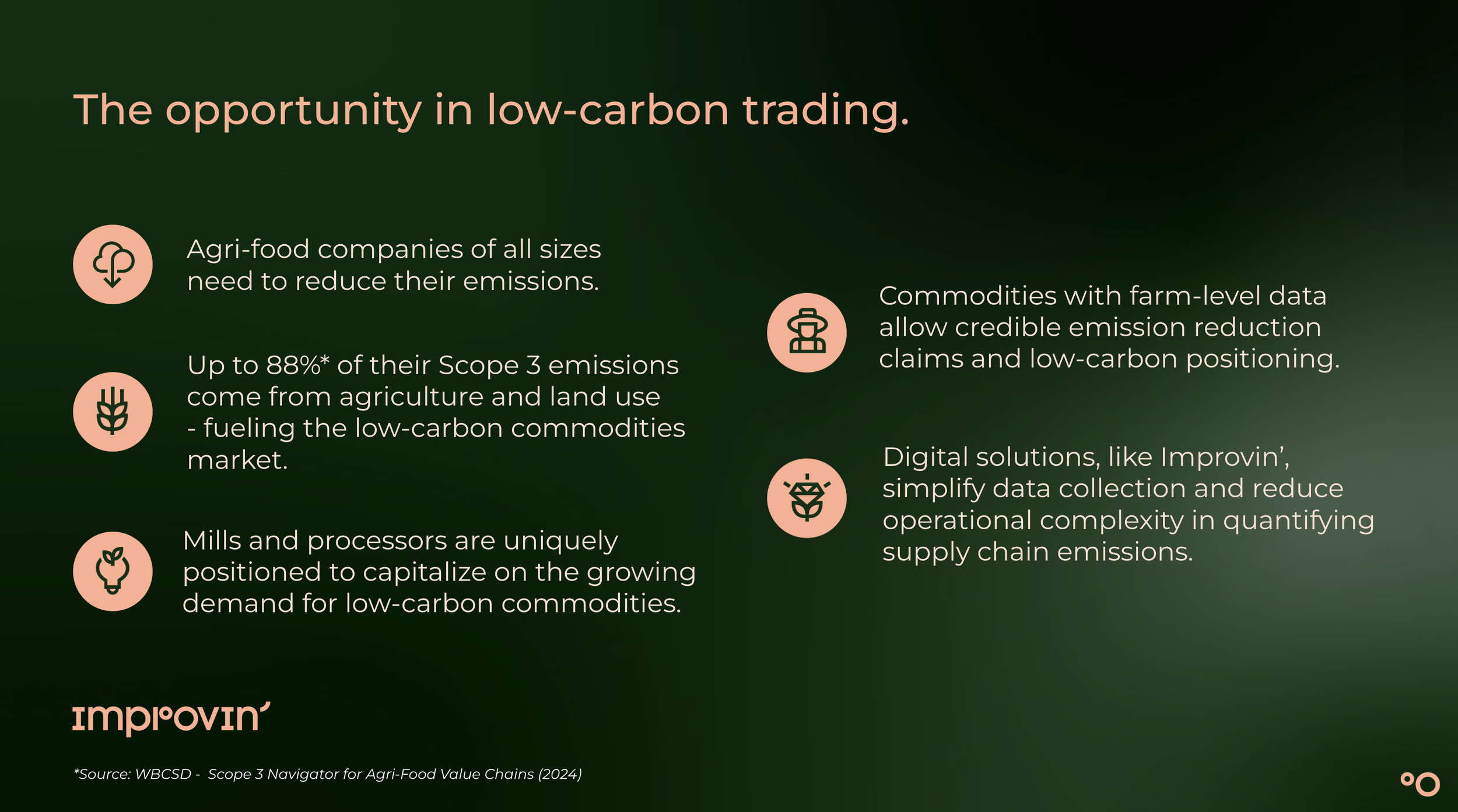
For agri-food companies specifically, up to 88% of their emissions are Scope 3 emissions, stemming from agricultural production and land use change. Agricultural Scope 3 emissions represent therefore the largest opportunity for impactful reductions.
Consequently, agriculture has become a key focus for agri-food companies pursuing their reduction targets, driving significant investment in a range of solutions - including commodities with lower emission footprints.

Image source: WBCSD - Scope 3 Navigator for Agri-Food Value Chains. (2024)
The commercial opportunity in low-carbon commodities trading.
Mills and processors are uniquely positioned to capitalize on the growing demand for more sustainable commodities.
Their ‘middleman’ position in the value chain, between the farmers and corporate buyers, allows them to transform sustainable agricultural practices into a key differentiating quality parameter, much like protein content or falling numbers have historically been.
By leveraging their established relationships with both farmers and corporate buyers, they can take ownership of driving positive environmental impact together with their farmers, unlocking many benefits: access to low-carbon price premiums and increased market shares, improved farm resilience and yield predictability, and future-proofed business against climate risks and evolving regulation.
However, just as with any differentiating parameter, to pay premiums based on carbon footprint, buyers will expect verified and transparent data to substantiate the claims.
To earmark specific commodity batches as low-carbon, mills and processors are expected to provide detailed information about the agricultural practices of each farm supplying the commodity.
This information must then be translated into sustainability metrics, such as carbon footprints, while ensuring that the link to the physical commodity volumes persists.
Generally, in an era of increased scrutiny, claims must be backed by robust data. Transparent farm-level data separates verified low-carbon commodities from vague marketing claims.
Previously, the collection and verification of necessary farm-level information has presented operational hurdles.
Recognizing this, Improvin’s infrastructure has been built specifically for mills and processors to streamline the data collection and carbon footprint quantification with batch-specific traceability.
Digital infrastructure to reduce the operational complexity.
With Improvin’s digital infrastructure, mills and processors can collect crop-specific activity data from their farmers, quantify the carbon footprints with the framework of their choice and link the sustainability data to sourcing contracts and sourced volumes – making the added sustainability values actionable and traceable to the field level.
In addition to delivering product carbon footprints to the commodity buyers, the infrastructure offers farmers valuable feedback loops on their carbon footprint and performance.
-
Are you ready to capitalize on the low-carbon opportunity?
Ultimately, low-carbon trading is a commercial opportunity for mills and processors.
By leveraging verified data and tools like Improvin’, you can stay ahead of market trends as well as regulations, meet buyer demands, and confidently differentiate your commodities in an evolving market.
Reach out to our team to learn how we can help.