Turning wheat data into action: Mondelēz and Improvin’ strengthen the Harmony Program with a Data Platform.
Mondelēz International consolidates its Harmony Program with a new data platform developed together with Improvin’.
The Harmony Program involves more than 1,200 farmers and value chain partners across eight markets, covering over 400,000 tonnes of wheat annually.
The new Harmony Data Platform enables scalable data collection, Harmony-specific KPI tracking, and transparent data sharing across the value chain.
By moving reporting from spreadsheets to the platform, Mondelēz ensures a more consistent and reliable way of working with data, faster reporting processes, and a data-driven approach to accelerate progress in the field.
Harmony Program: A long-term commitment to sustainable wheat.
One of Europe’s most ambitious sustainable wheat standards, the Harmony Program by Mondelēz International is advancing digital value chain collaboration.
Launched in 2008, the Harmony Program aims to make the European wheat supply more sustainable by reducing greenhouse gas emissions, preserving biodiversity, improving soil health, and supporting farmers in the transition to regenerative practices. By 2030, Mondelēz’s goal is to grow 100% of the wheat volume needed for European business biscuits production under the strengthened Harmony Regenerative Charter.
Each year, Mondelēz sources around 400,000 tonnes of wheat through the Harmony Program. The program brings together the entire value chain: wheat mills, cooperatives and more than 1,200 farmers in France, Belgium, Spain, Italy, Poland, the Czech Republic, Hungary, and Germany.
“Harmony has always been about restoring the balance between agriculture and nature,” says Guillaume Sauzay, Harmony Program Lead at Mondelēz International.
“Together with Harmony farmers, we have been scaling regenerative practices and biodiversity protection across Europe. Our new Harmony Data Platform helps us digitize the program and inform our strategic decisions to strengthen the resilience of our farmers and supply chain through data-based decision-making.”
From spreadsheets to a Data Platform.
Until recently, the Harmony Program relied on manual data collection through spreadsheets. As the program grew, so did the complexity of gathering reliable data across multiple countries and program partners.
“We wanted to make it easier for all Harmony partners to report and track the program, using a shared platform,” Guillaume Sauzay explains. “The platform helps us keep all data in one place and ensures that it’s reliable, secure, and accessible for everyone in the value chain.”
Developed by Improvin’, the new data platform ensures fast and scalable data collection, translating data into Harmony-specific KPIs. All Harmony partners across the markets have access to tailored features that help them support farmers to focus on progress instead of paperwork. Farmers receive results on the impact of their improved practices.
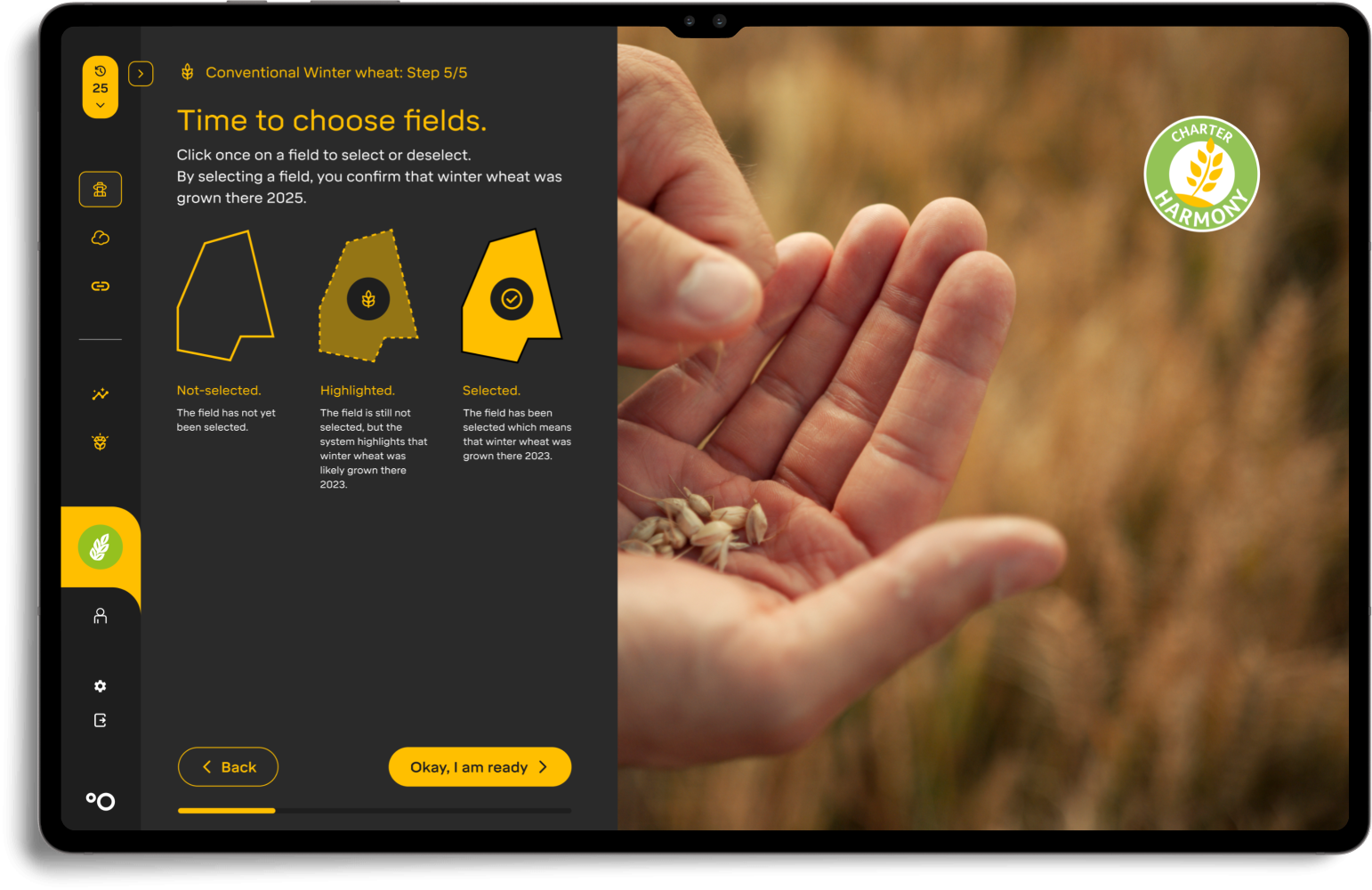
Harmony Data Platform.
“Our role as the technology provider is to ensure consistent and reliable data flows across the Harmony network, enabling easier data operations and making farm-level data accessible for everyone in the value chain”, says Niklas Wallsargård, CEO and co-founder of Improvin’.
“Together with Mondelēz and Harmony partners, we’re building a platform that helps turn data-backed insights into measurable action in the fields.”
While technology plays a key role in ensuring data consistency and traceability, hands-on support remains central to the Harmony Program. Close collaboration and agronomic advice for farmers ensure that data translates into practical improvements on the ground.
Choosing the right partner.
Selecting the right technology partner was a critical step in bringing the Harmony Data Platform to life.
For Mondelēz, ease of use across the value chain and flexibility to adapt to value chain setups that vary among sourcing regions were key priorities.
Rather than building an in-house system requiring dedicated technical resources and maintenance, Mondelēz chose a platform purpose-built for scalable data collection in the agri-food industry.
“Improvin’ combines strong technical expertise with a deep understanding of agricultural operations, which we valued highly during the evaluation,” Guillaume Sauzay says. “The platform is designed to evolve with our needs and makes it easy to connect and trace data transparently across the value chain.”
Additionally, Improvin’ was recognized as a leading technology provider in the sector. Because its infrastructure was already used by numerous agribusinesses and cooperatives, and it offers an internationally rewarded user experience, Improvin’ became a natural fit for the program’s expansion.
Rolling out and looking ahead.
The rollout of the Harmony Data Platform began with data alignment and training across key program partners. Improvin’ joined the Harmony tour to introduce the platform and support onboarding for mills and cooperatives.
During the first two years of collaboration, data collection has taken shape in a hybrid setup, combining both direct farmer reporting and indirect reporting. Smart processing of data uploaded from spreadsheets, CAP files, and FMS exports has ensured a smooth transition and continuity in data quality.
Together, Mondelēz and Improvin' are working on continuous improvements to make the Harmony Data Platform a user-friendly tool for knowledge-sharing, feedback, and simulations.
“It’s inspiring to see how Mondelēz continues to advance one of Europe’s most established and ambitious sustainable wheat programs. The Harmony Data Platform now gives all program partners a single source of truth to collaborate, measure progress, and drive real impact”, concludes Niklas Wallsargård from Improvin’.
-
About the Harmony Program
Launched in 2008, Mondelēz International's Harmony Program is a pioneering initiative aimed at creating a more sustainable European wheat supply. The Harmony Program’s ambition is to cultivate 100% of the wheat needed for its biscuit production by 2030 under regenerative agriculture principles by addressing major agricultural challenges: reducing greenhouse gas emissions, preserving biodiversity, and supporting farmers in their transition to more sustainable practices.